
Well, it’s official…. finally. I am Autistic and most probably “inattentive ADHD” as well.
I mean, I already knew. This was not new information. But there was that imposter syndrome looming. Not trusting my own education and instincts, once again.
I firmly believe in self-diagnosis. I really do. It is honestly a privilege. A privilege that many don’t have because of the area or country they live in, they can’t afford it, etc etc. There are many intersectional reasons.
It has taken about 3 years.
My first step was calling my GP surgery and requesting a referral. Honestly, I think I was lucky, as that conversation went well, and my GP agreed to refer me. So I waited for the next step, which was a pre-assessment by a charity. I’m not sure how long I waited for that online appointment. But I was nervous and pleased when the date came.
I was definitely quite surprised to find that the primary assessor of the two in the appointment meeting was AuDHD ( Autistic and ADHD). She told me before we even started, and I was immediately at ease. The assessment was quite conversational, as well as asking me various questions using ADOS and, I think, the Autism Diagnosis Interview (revised. ADI-R).
At the end of the assessment, the assessor confirmed that she believed I was Autistic and also “inattentive” ADHD. The ADHD part I had not even considered before, so that was a bit of a surprise, to say the least. The assessor also told me that they were explicitly requesting that I was sent to a specific centre to be officially diagnosed because I really don’t have anyone (alive) to assist in informing how I was as a child.
So the day came again for the official online assessment. It went quickly and to be honest now, it’s a bit of a blur. But I remember the assessor being kind. I also remember the assessor mentioning Asperger’s which I immediately shot down for various reasons. Main one is that Hans Asperger was a Nazi.
So I asked the assessor to not put anything about Asperger in my diagnostic summary. Thankfully they agreed.
Then came the wait for the summary. I remember thinking it was taking ages . Then it came and I was asked to “approve” it. I had to add to my summary reply that the language used was deeply problematic ..
But I’ll get onto that a bit later .
The fact that part of the diagnosis for autism, even in adults, is to investigate behaviours in childhood is because the diagnosis is based on behaviours and deficits. Personally, I find the “need” to investigate childhood behaviours specifically in an adult diagnosis flawed, to say the least. It doesn’t consider autistic masking see research here in any way, and I consciously and unconsciously masked my entire childhood.
I genuinely want more Autistic Professionals at first diagnosing and then changing the diagnosis completely. I want the diagnosis changed to the social model of disability –see here– and far from the medical model it currently uses. I am not saying the Social model is perfect. The Social Model certainly isn’t perfect, but far better than the medical model presently used.
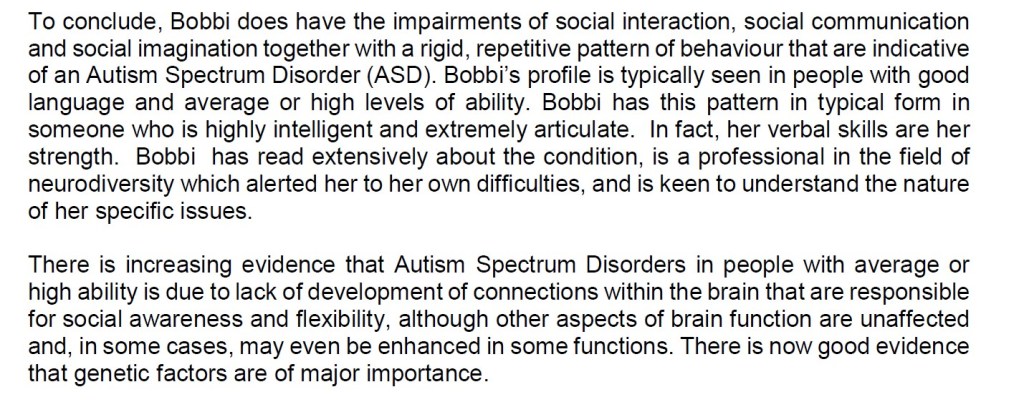
The above text is taken directly from my final diagnostic summary. I’ve included it because it highlights precisely my point regarding the medical model vs the social model. I have “impairments” with “lack of development of connections in the brain that are responsible for social awareness and flexibility”, according to this medical model based assessment.
I have over 17 years of working with Autistic children and their families; I have two now adult AuDHD ( Autistic and ADHD) children. I have read many diagnostic and professional reports over those years. But this repost? My own report? It did hit hard in places. Specifically the last three pages of “recommendations”. The above section I’ve included was mild in comparison to some of the other sections.
Now, I understand this report, coming via the NHS, will have a template of “recommendations”. I get that. But, my goodness, telling me this ?
“Thinking in Pictures by Temple Grandin would be useful for learning about visual thinking as well as sensory processing difficulties.”
Temple Grandin is no friend to the Autistic Community, and I was pretty shocked to see her recommended – see here for exactly why Temple is problematic -.
Of course, the summary recommended the National Autistic Society, which sadly is also problematic with no Autistic people at senior levels in the charity and other reasons – see here – here – and- here – but they are involved in NHS Adult diagnostic assessment.
“Bobbi has difficulties relating to processing sensory and motor information.”
Every single recommendation has a medical model deficit slant. Instead of saying I have differences, I have “difficulties.”
- Anxiety & Anger and impulse control
- Ruminative thinking & learning to manage intrusive thoughts.”
They didn’t consider Alexithymia – see explanation here– in the above “summary”. No mention of it in any way, and I know Alexithymia is something I definitely experience. I experience my emotions differently. I am also hyper empathetic – see live on Hyper Empathy here– which, for me, means my affective Empathy- the emotions you feel- is immediate with little control. It has been that way my entire life.
Because of unconscious masking and fawning, I will cry with any emotion felt. That is my effective Empathy at play. I am angry; I cry. I am happy; I cry. I am hurt; I cry. The only time I don’t immediately cry is when my sense of right and wrong is challenged. For example, if I see bigotry. Then, I really get angry. So, is it really “anxiety and anger control”, or is it quite literally a difference in experiencing emotions to those not Autistic?
“Ruminative thinking & learning to manage intrusive thoughts”.
“Ruminative thinking”, or could it just be Monotropism – see here- at play? It couldn’t be that I talked about my passions and “losing time” deep diving into them. No, we need that deficit slant (*sarcasm*). That continued stigma attached to Autistic people. The fact that we can and do deep dive into our passions is not seen as something to be valued and praised even, but rather again, the medical model comes in, and we are othered.
“Learning to manage intrusive thoughts”. Honestly, I am not even sure why this was included. I don’t have intrusive thoughts. I did ( TW) have suicidal ideation briefly in my teens. But there was a direct connection between the death of my father and that time. I have never dealt with OCD and compulsive thoughts, though I know very well many other Autistic people have. – See here for a fantastic blog on intrusive thoughts and other subjects- Again, I believe this is part of a template the NAS (National Autistic Society) uses.
- Empathy
- Social Interaction and improving social skills
Well, where to start with this one. Double Empathy D. Milton – see here- is a good place. “Social Interaction and improving social skills”. No mention of the Autistic community and how we autistic people find it easier to “socialise” with other Autistic people? I definitely find it easier. Again, “improving social skills” means non Autistic “social skills” ideals. In other words, masking – see here- to meet non Autistic expectations of “social skills” in social situations. There is nothing about Autistic social skills, which are apparent when we are with other Autistic people. But only recommendations that would encourage masking.
I could go on and on breaking down all the Medical Model language in the Diagnostic Assessment Summary, but you get the idea. But I Will include one last screenshot.

As I mentioned, I am a 54-year-old female presenting a person with two adult AuDHD children. I have raised my children and worked successfully as a pro makeup artist before having children. I also worked once they were settled in school, for over eight years as a Higher Level TA (teaching assistant) working 1:1 with specifically Autistic students only in a mainstream primary. After that, I worked for a year on an LA Autism Advisory Team. I now work as a Coach, Consultant and Educator of the Autistic experience.
To say this comment in my final assessment was patronising to me is a bit of an understatement. Doesn’t everyone want instructions to be concrete and explicit? Doesn’t everyone appreciate language that is clear and unambiguous? Clarifying someone understood what was said is expected, isn’t it? There is no reason to tell me to write things down. I have attention difference (ADHD) and have been doing that my entire life already.

I would say that non Autistic people tend not to mean what they say. Many have no intention of knowing really how your day went and “how you are doing”. Therefore, again we have the view of me through the Medical Model. The ownness is on me to change, not those Non Autistic, to educate themselves on how I communicate and interact.
I know many of those newly diagnosed are left feeling worse or have very conflicting emotions, and it is no wonder why after reading my own diagnostic summary. What is sad to me is I have the ability needed to critically look at my summary, having a post grad as well in autism as well as my years learning from Autistic Professionals, Academics and Advocates, other adults and young people being diagnosed, do not. How do they feel reading their diagnostic summary?
We need a change to the whole diagnostic criteria and system.
If you or someone you know is newly diagnosed Autistic, This is a great place to start. HERE or the link below.


 Bobbi Elman: NeuroDivergent Autistic Experience Consultancy & Training™